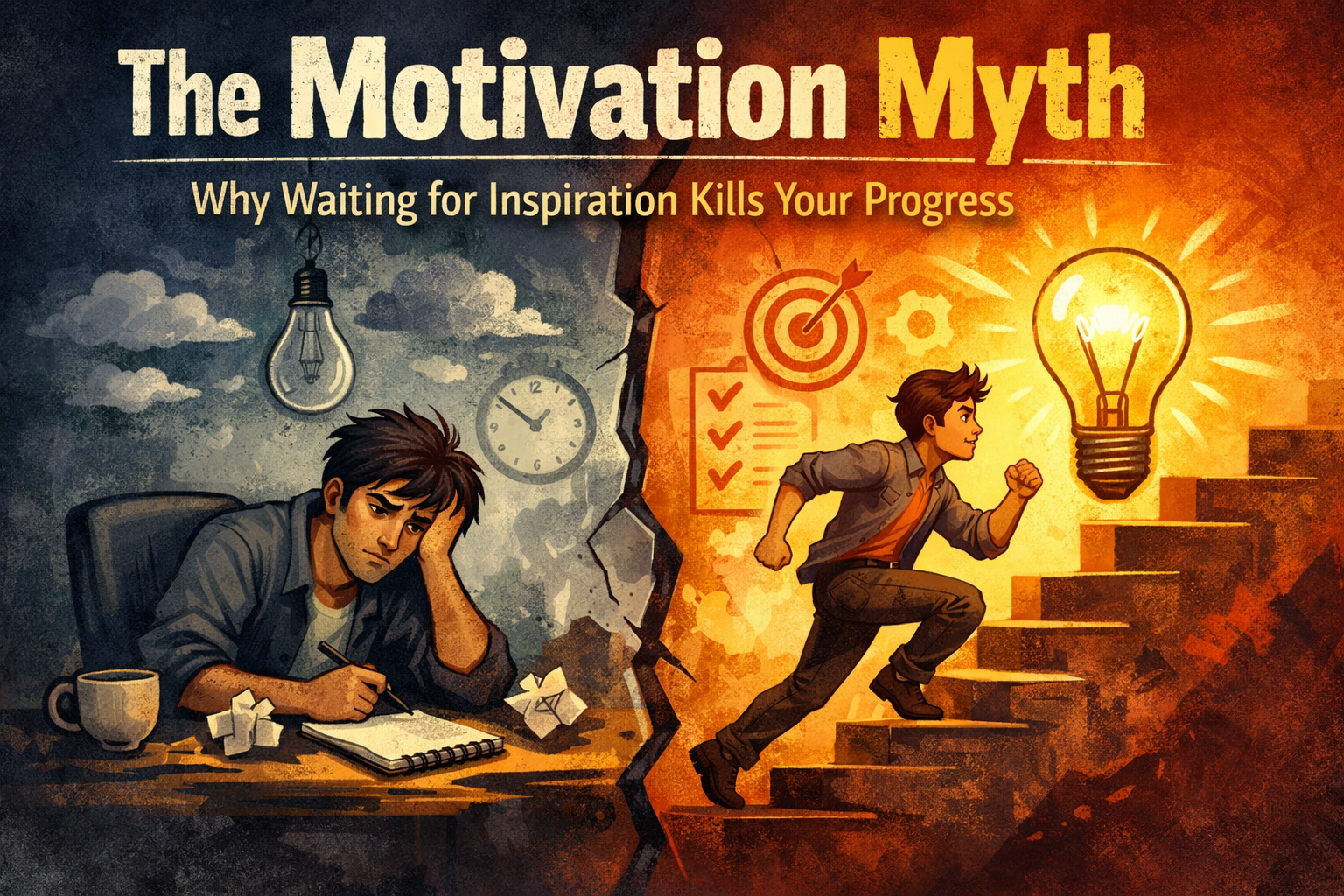
The Motivation Myth: Why Waiting for Inspiration Kills Your Progress
We’ve all had the experience. The empty screen, waiting for that “perfect idea” to strike. Your desk is occupied in anticipation of the rush of enthusiasm to fill the entire body prior to tackling the difficult work. You say to yourself “I’m just not feeling it today,” and then you delay your most important task until the next day, hoping motivation will come your way.
It is among the biggest traps that can befall you in the realm of personal as well as professional productivity. A belief that motivation is a requirement for taking action, a supernatural source that needs to find you before you begin, is mythology that has derailed numerous goals that laziness never would. Actually, waiting for inspiration is a method of avoiding action in a culture where action is the most rewarding.
The Inspiration Trap
We romanticize creative genius, writers waiting for inspiration or inventors struck by lightning bolts of ideas. In reality, this “waiting game” is often just delayed progress disguised as preparation.
When you wait for motivation, you become a passenger in your own life. Some days you’re a star; other days you accomplish nothing. This inconsistency kills growth.
The truth: motivation isn’t the cause of success, it’s the result. Satisfaction comes from doing the work and seeing progress. Action precedes motivation, not the other way around.
This is where strategy matters. Disciplined effort is powerful, but direction matters more. Using product review competitive intelligence tips reveals what customers truly want and where competitors fall short. It ensures your energy is invested wisely, turning blind action into strategic progress.
Related:





Discipline Over Feeling
If your motivation doesn’t have a reliable time-line and discipline is what you need to be, it’s the strong roof that you construct over yourself. The ability to discipline yourself is being able to perform the task that you promised to do long after the mood you stated that it was going to do has passed.
It’s a key element to personal growth. When you make a choice to choose the path of discipline instead of comfort and comfort, you are sending a strong signal to your brain that says: “My commitments are more important than my temporary feelings.” You establish trust in yourself. You’re now trustworthy to yourself.
Consider physical activity. Nobody gets from bed at 5:45 am to race in the freezing cold. It’s because the person who runs does this due to the value of the long-term benefits (health and energy, long-term durability) rather than temporary discomfort. They aren’t waiting to feel like they’re running. They do it which means that they feel you feel like an athlete.
It’s the same with your work life. The most effective people don’t have to be constantly motivated, they’re the ones who’ve created structures that work without inspiration.
How to Start When You Don’t “Feel Like It”
The question is, how can you stop waiting? What are the best ways to create positive momentum forward when your tank is full? The solution lies in shifting the focus of your efforts from huge results to micro-scale actions.
1. The Five-Minute Rule
The most difficult aspect of any job is navigating between “resting” to “doing.” For this to be accomplished, grant yourself the permission to work within five minutes. Anybody can stand for five minutes of boring spreadsheet or an arduous email.
Most of the time, those five minutes can be enough to gain a bit of cognitive momentum. It becomes clear that the job isn’t quite as difficult as your mind thought, and you continue working.
2. Optimize Your Environment
The physical environment you live in affects your mood. If you have a desk that is messy and your surroundings seem stale and uninviting, your brain will associate this space with anxiety or apathy.
Utilizing visual cues to communicate “focus mode” to your brain (and your coworkers) will trick your brain to enter a state where it is flowing. If your surroundings are optimized for working at a high level it is not necessary to be able to concentrate, simply be comfortable and allow the surroundings to help your focus.
3. Leverage Curiosity
If you’re unable to find passion to complete a project you should tap into your curiosity. Instead of stating, “I have to finish this report,” you should ask, “I wonder what the data will reveal if I dig a little deeper?”
Moving from a mindset of performance (I must be able to finish this task well) towards a learning mindset (I wonder what I’ll uncover) lowers pressure and allows you to start more easily.
The Role of Strategy and Tools
When it comes to work and especially in the field of focus on efficiency, it’s important to be sure that whatever effort you’re taking on can actually be moving the needle. In the absence of discipline, an improper task remains an ineffective way to spend your time.
This is the place where strategic thinking intersects with productivity. Prior to launching into an undertaking, you need to be aware of the terrain. If, for instance, you have a plan to develop a new service or product it is important to understand the competition.
It is important to look outwards to find out what works on behalf of others. It is possible to research the market leaders. This is the point at which competition intelligence for product review techniques are useful.
When you analyze customer reviews regarding rival products, you are able to discern gaps in the marketplace as well as features that customers want. Your disciplined task into an intelligent one to ensure that the time you put into it isn’t wasted at a loss.
Redefining Progress
Another reason why we are waiting for motivation is because we have the wrong perception of what progress is. It is thought that progress refers to an end product or a contract signed or an ideal draft. However, progress can be difficult to see.
It shows progress when you are ready to stop. It’s writing a paragraph, when you intend to complete a whole chapter. The progress is closing all your distractions web browser tabs and staying focused on your task for 20 minutes.
In celebrating the small wins, you generate the dopamine rush that the brain needs. Dopamine is a substance that motivates you. It is a way to reverse engineer inspiration. You acted and won a small win that you are now driven to carry on.
Conclusion
The best performers, artists and business owners don’t sit for inspiration. They get up early and head to work. They realize that inspiration isn’t a lightning bolt, but rather an open fire that starts out modestly, and requires a little bit of igniting (action) then grows by energy (consistency).
Don’t lie in the dark in wait for the illumination to come upon you. Make the match on your own. Set up the systems, build the conditions, and then take the first step. Your motivation will be waiting to finish your work that you’ve been putting off.